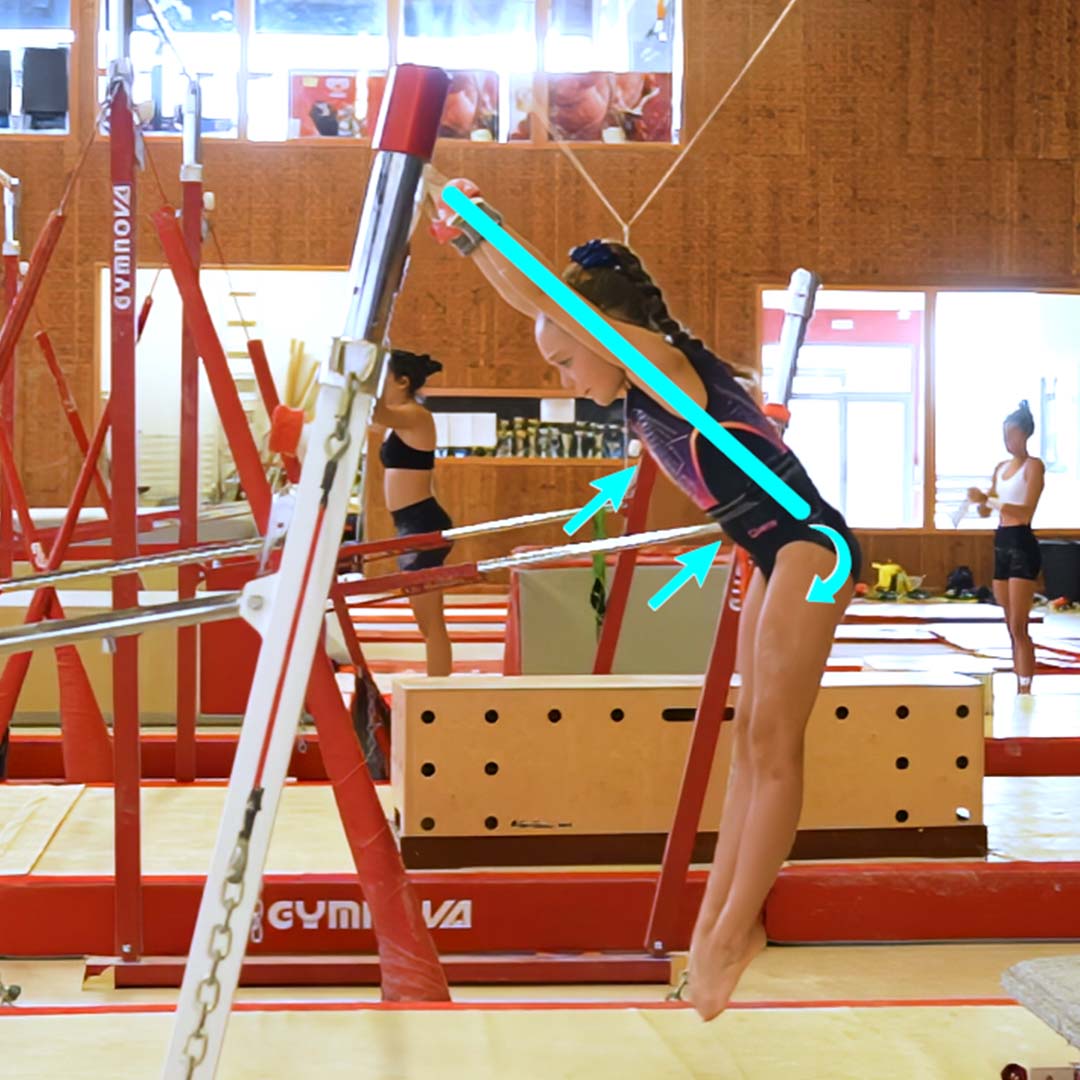
Swing with legs together on the low bar (kip swing)
Discover how to teach the swing with legs together on the low bar to your gymnasts



Angelo Ritorto
Swing with legs together on the low bar (kip swing)
Discover how to teach the swing with legs together on the low bar to your gymnasts
description
The swing with straight legs on the low bar is one of the technical elements that all gymnasts must master in order to progress on the uneven bars.
These swings, which often precede kips, are physically demanding and require thorough pedagogical work to be mastered.
In this training course, we will analyze the technical actions and the prerequisites to teach them, then we will detail the learning progression in three stages:
- the discovery of body positions and the linking of the first swings;
- the specific work on the transition phase between the backward swing and the forward swing;
- and the cast from a start in a standing position.
Through progressive drills and precise coaching cues, you will develop your skills and optimize your gymnasts’ learning process.
We wish you an excellent training session.
Associated books
Let's teach gymnastics bar skills
Learn how to teach:
• Kip • Bent-leg swing • Swings with legs together • Forward swings • Backward swings • Swing half turn
All the exercises needed to learn kip and basic swings on uneven bars, from their beginnings to the execution of complete skills
→ 165 exercises - 213 pages - Format 15 x 21 cm -
A note on the series of books, "Let's teach gymnastics":
• Our books are essential companions to the video training on the same topics that you find in the section "Gymnastics Education" here on GymneoTV.
• Their spiral binding and tabbed pages allow you to quickly find the skills you want to look at, and easily locate the drills and training stations.
• The summaries of technique and the large format illustrations made to scale make these books the ideal companions to your training sessions.
Our advice:
• For training session prep: thanks to the technique summary and icons at the top of each page, you can easily find the stations that match the current needs of your gymnasts. You can also anticipate the equipment needs for your upcoming session.
• During training: with the help of realistic images, you can save time by showing your gymnasts the drills to work on. They will also be able to help you set up the training stations and thanks to the illustrations, they'll more easily understand the task at hand.
• You will improve the constant exchange that you have with your athletes. In fact, when giving your instructions, the illustrations create common ground for discussions or reference points. They make it easy to understand and/or visualize technical placements, which makes it much easier to learn the element.
content